When Your Brand Colour Goes Wrong in Print: Why It Happens and How Print Lord Stops It
You approved the design on screen. It looked sharp, vibrant, exactly right. Then the prints arrived and your signature crimson had turned a muddy burnt orange. Your deep navy looked closer to black. The gold that was supposed to gleam had gone flat. Sound familiar? You are not alone, and more importantly, it is not your fault. Colour going wrong in print is one of the most common, most avoidable disasters in the industry, and it happens because most printers never bother to warn you it is coming.
Print Lord does things differently. Here is exactly why colour disasters happen, and how they are stopped before a single sheet rolls through the press.
—
Why Your Screen Is Lying to You: RGB vs CMYK
Every screen, whether it is your laptop, your phone, or your designer’s monitor, displays colour using RGB: red, green, and blue light combined in varying intensities. It is a light-based system capable of producing vivid, luminous colours that literally glow.
Print does not work with light. It works with ink. And ink uses a completely different colour model called CMYK: cyan, magenta, yellow, and key (black). When you mix light, colours get brighter. When you mix ink, colours get darker. The two systems do not map neatly onto each other, and that gap is where the trouble begins.
If your artwork is supplied in RGB and sent straight to press without conversion, the printer’s software will make its best guess at translating those colours into CMYK. Sometimes it gets close. Often it does not. The result is that electric blue becoming a muted slate, or that vibrant coral shifting to a dull terracotta.
The fix is straightforward: artwork should always be converted to CMYK before going to press, and that conversion should be done carefully, with a human eye checking the result. At Print Lord, that step is never skipped.
—
How Paper Stock Changes Everything
Even a perfectly converted CMYK file can look very different depending on what it is printed on. Paper stock has a huge effect on how ink sits, absorbs, and reflects light, which in turn changes how colour appears to the eye.
Uncoated paper is porous. Ink soaks in slightly, which tends to soften and slightly deaden colours. If your brand relies on bold, punchy tones, uncoated stock can work against you unless the artwork is adjusted to compensate.
Silk and gloss coated stocks are less absorbent. Ink sits more on the surface, colours appear richer and more saturated, and contrast is stronger. Gloss, in particular, can make colours pop in a way that uncoated simply cannot match.
Matt lamination and soft-touch finishes add another layer of complexity. Both can shift the perceived depth of colour, often making things feel cooler or slightly muted compared to what you see in the proof.
None of this is a problem, as long as someone tells you in advance. Print Lord briefs clients on exactly how their chosen stock will behave with their specific artwork, before anything is committed to press.
—
The Silent Culprit: Monitor Calibration
Here is one that surprises people. Even if your artwork is perfectly set up in CMYK and your stock choice is ideal, what you see on screen may still not match print, because your monitor may not be accurately calibrated.
Most screens ship from the factory set to display colours in a way that looks attractive on a retail shelf, not necessarily in a way that is accurate to print standards. Over time, screens drift further. Brightness, contrast, colour temperature, and gamma all affect how colours render, and if your monitor is showing you colours that are warmer, cooler, brighter, or more saturated than reality, you will be making decisions based on inaccurate information.
This is one reason Print Lord never relies solely on a client’s screen approval for colour-critical work. Proofing, Pantone references, and calibrated in-house checks all play a part in making sure what gets printed is genuinely what was intended.
—
Pantone Matching: When Precision Is Non-Negotiable
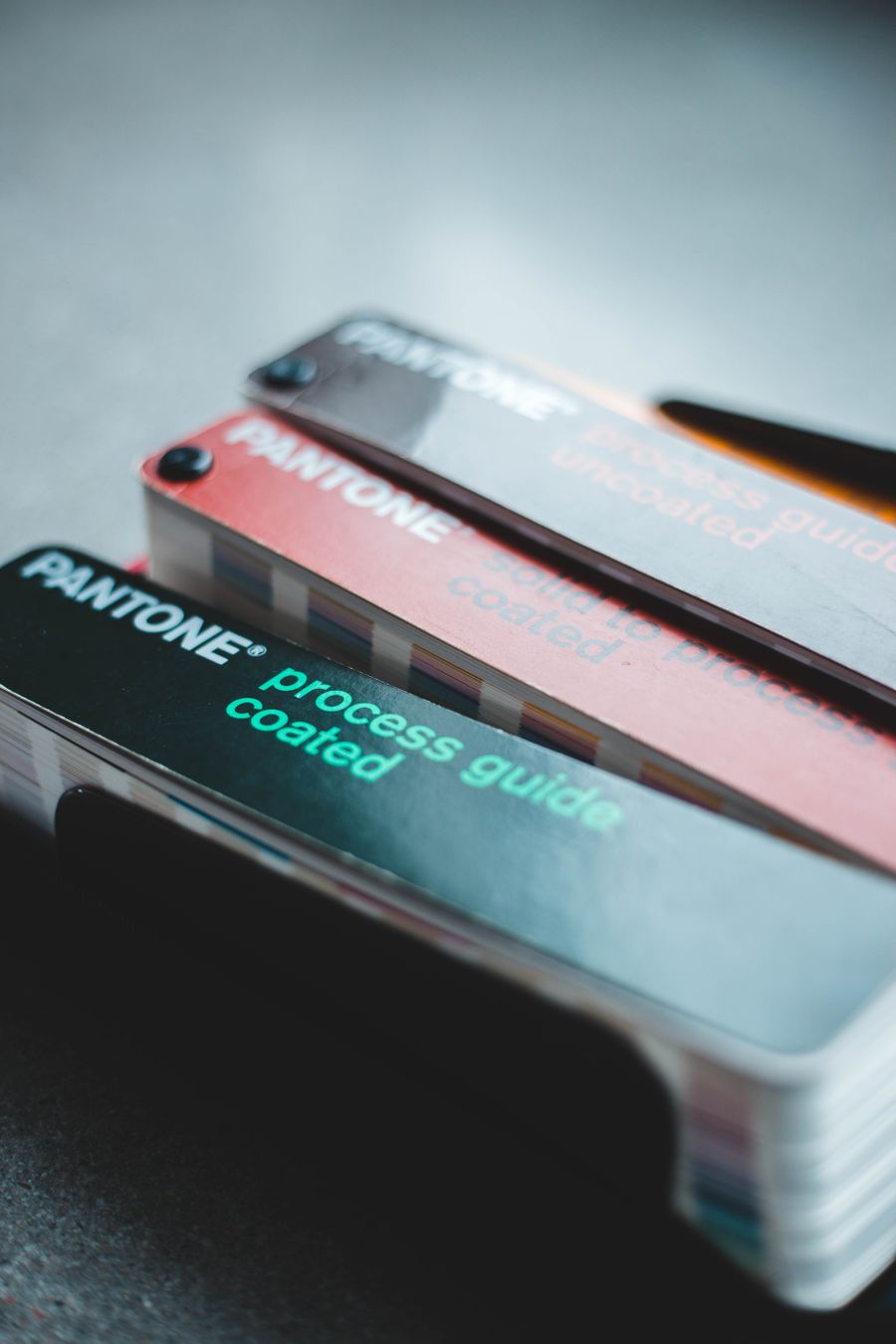
For brand colours that absolutely cannot shift, Pantone is the answer. The Pantone Matching System is an internationally standardised library of colours, each with a unique reference number. When a brand colour is specified as a Pantone reference, it can be matched precisely on press regardless of monitor differences, CMYK conversions, or stock variations.
This is particularly important for logos, corporate identities, and any print work where colour consistency across multiple jobs and suppliers is essential. If your brand has a Pantone reference for its primary colours, that reference should be on every print brief, every time.
If your brand does not yet have Pantone references defined, Print Lord can advise on identifying the closest matches to your existing colours, giving you a solid foundation for consistent print going forward.
—
How Print Lord Prevents Colour Disasters
Most click-to-basket printers accept your file, run it, and ship it. If the colour is wrong, that is your problem. Print Lord operates on an entirely different principle.
Every file that comes into Print Lord is checked before it goes anywhere near a press. Scribe Gavin, Print Lord’s in-house typesetter and proofer, reviews artwork for colour mode, resolution, bleed, and any flags that could cause a problem in production. If a file arrives in RGB, it is flagged. If the colour profile looks like it will shift badly in conversion, the client is told. If there is a mismatch between what the brief describes and what the file will actually produce, that conversation happens before press, not after delivery.
This is what proactive brand guardianship looks like in practice. Not just printing what arrives, but taking responsibility for the outcome.
For colour-critical jobs, Print Lord offers Pantone advice, press proofing options, and honest guidance on which stock and finish will best serve the intended result. The goal is always the same: the client receives something they are proud of, that looks exactly as their brand deserves.
—
Make Your Mark This Summer, in the Right Colour
Summer is the season for standing out. Events, festivals, hospitality, exhibitions, seasonal campaigns, all of them need print that looks sharp, on brand, and exactly right. A colour disaster at this time of year is not just frustrating, it is costly, both in reprints and in reputation.
Print Lord takes colour seriously because your brand deserves nothing less. Whether it is a run of exhibition banners, seasonal menus, branded merchandise, or a major campaign, every job gets the same standard of care: expert advice, rigorous file checking, and the confidence of knowing nothing leaves the shop unless it is right.
Got a colour-critical job coming up? Talk to Print Lord before you brief anyone else.
Email: hello@printlord.co.uk
Phone: 01273 526679
Shop: shop.printlord.co.uk
Print Lord. At your service. On brand. On time.